
 Kapil Garg
 Most teams do not lose productivity because people avoid work. They lose it because work is poorly structured and workplace efficiency is overlooked. On average, employees spend 30 to 40 percent of their workday on low value activities such as unnecessary meetings, rework, and task switching. That means in an 8 hour workday, nearly 3 hours are lost without producing meaningful outcomes.
Workplace efficiency focuses on fixing how work is planned, executed, and reviewed, not on pushing people to work longer hours. When goals are unclear, priorities change daily, and time usage is invisible, teams struggle to deliver results even when effort is high. Many organizations try to improve productivity first, but productivity cannot improve sustainably when efficiency gaps remain unresolved. This relationship is explained clearly in our guide on increasing productivity in the workplace, which shows how daily work structure impacts performance.
In this guide, you will learn how to improve workplace efficiency using practical and measurable methods. We will explain what workplace efficiency really means, the real cost of inefficiency, and how to measure efficiency the right way. You will also learn proven ways to reduce wasted time, rebalance workloads, and improve focus so teams can achieve more without burnout or micromanagement.
What Is Workplace Efficiency?
Workplace efficiency refers to how effectively time, effort, and resources are used to achieve meaningful results. It is not about working faster or longer. It is about reducing wasted effort and making sure that most work hours contribute directly to business goals.
In simple terms, a team is efficient when it can deliver consistent outcomes with less rework, fewer delays, and better use of time. For example, if two teams work the same 8 hour day but one team spends only 5 to 6 hours on focused work while the other loses time to meetings and interruptions, the first team is more efficient even if both appear equally busy.
Workplace efficiency and employee productivity
Workplace efficiency and employee productivity are closely related, but they are not the same. Productivity measures how much output is produced, while efficiency looks at how that output is achieved. A team can appear productive in the short term while still being inefficient due to long hours, overload, or constant firefighting.
This difference becomes clearer when productivity is measured without understanding how time is spent. That is why many organizations struggle when they focus only on output numbers. Our guide on how to calculate productivity of an employee explains why productivity metrics alone do not always reflect real performance.
Efficiency as a system level outcome
Workplace efficiency is a result of systems, not individual effort. Clear goals, defined responsibilities, realistic workloads, and visibility into time usage all play a role. When these elements are missing, inefficiency spreads even among skilled and motivated employees.
Organizations that improve efficiency at the system level often see measurable results. Teams complete tasks with fewer revisions, projects stay closer to planned timelines, and decision making becomes faster because data replaces assumptions. Over time, this leads to stable performance without burnout or constant pressure.
Consequences of Poor Workplace Efficiency
Poor workplace efficiency creates problems that are often invisible at first but become costly over time. These issues do not appear overnight. They build slowly through small delays, repeated mistakes, and wasted effort until performance and morale start to decline.
Operational cost leakage
When work is inefficient, costs increase without obvious warning signs. Research shows that businesses lose 20 to 30 percent of their operating costs due to inefficient processes, rework, and poor coordination. This happens when employees spend hours fixing avoidable issues, waiting for approvals, or repeating tasks that were not done right the first time.
For example, if a team of 10 employees loses just 1 hour per employee per day, that becomes 50 lost hours per week. Over a month, this turns into hundreds of paid hours with limited output. These losses directly affect profitability, even when revenue appears stable.
Employee burnout and disengagement
Inefficient workplaces place constant pressure on employees. When priorities change frequently and workloads are uneven, employees are forced to compensate by working longer or by rushing through tasks. Over time, this leads to burnout.
Surveys consistently show that more than 60 percent of employees feel burned out due to unclear expectations and poor workload management. Burnout reduces focus, increases errors, and lowers engagement. It also increases the risk of retention problems, which is why it is important to address root workplace issues early. If you want a deeper view on this, read employee retention fix workplace issues.
Missed deadlines and revenue impact
Inefficiency also affects delivery timelines. Studies indicate that nearly 70 percent of projects miss their original deadlines due to poor coordination and unrealistic scheduling.
Missed deadlines damage trust with clients and internal stakeholders. Sales teams struggle to make commitments, managers lose confidence in forecasts, and leadership decisions are delayed. Over time, these issues reduce growth opportunities and create instability across the organization.
Common Challenges That Reduce Workplace Efficiency
Workplace inefficiency usually comes from a few recurring challenges that teams face every day. These issues often feel normal, which makes them harder to notice. Over time, they reduce focus, slow down progress, and create unnecessary stress across teams.
Unplanned and reactive work
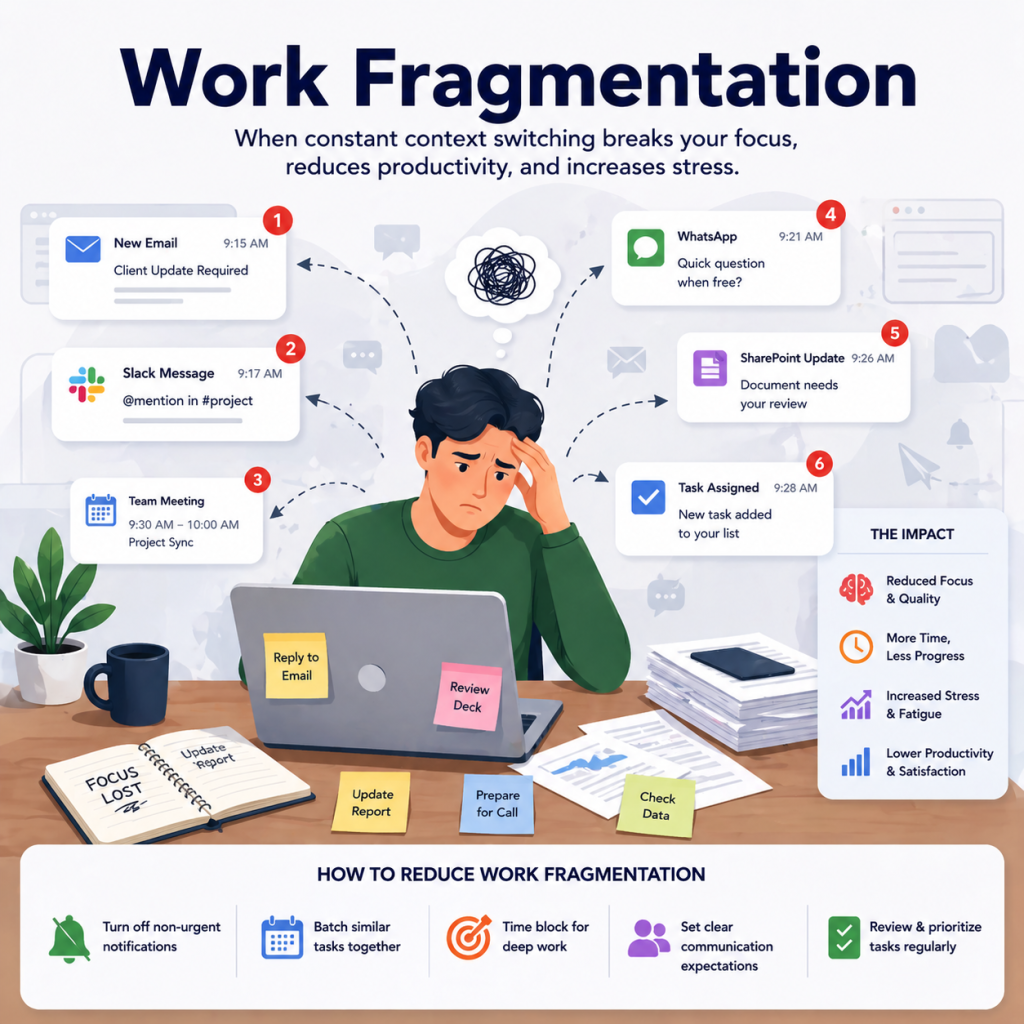
Many teams spend a large part of their day reacting instead of executing planned tasks. Urgent requests, last minute changes, and unclear priorities force employees to constantly switch focus. Studies show that employees lose up to 40 percent of their productive time when work is driven by interruptions rather than planning.
When teams operate this way, important tasks get delayed while low value work consumes most of the day. Without a clear structure, even skilled employees struggle to make progress.
Lack of time visibility
One of the biggest efficiency challenges is not knowing where time actually goes. When teams do not track how time is spent, decisions are based on assumptions instead of facts. Managers may believe workloads are balanced, while some employees are overloaded and others are underutilized.
This lack of visibility makes it difficult to identify bottlenecks, estimate timelines, or plan future work accurately. It becomes even more critical for distributed teams, where coordination depends on clear scheduling and shared expectations. If your teams work across locations, this guide on managing teams in different time zones can help you reduce confusion and improve alignment.
Unclear goals and ownership
Efficiency breaks down when employees are unsure about what they are responsible for. When goals are vague and ownership is not clearly defined, tasks get duplicated or ignored. Teams end up spending time clarifying responsibilities instead of completing work.
Clear goals and ownership reduce confusion and help employees focus on outcomes instead of constant coordination.
Excessive meetings and interruptions
Meetings are necessary, but too many meetings reduce focus and drain energy. Research indicates that employees attend 10 to 15 meetings per week on average, many of which lack clear agendas or outcomes. Each interruption forces employees to restart their mental focus, which slows down progress.
Reducing unnecessary meetings and protecting focused work time helps teams complete tasks faster and with fewer errors.
Inefficient workflows and tools
Outdated processes and disconnected tools create friction in daily work. When employees need to switch between multiple systems or follow manual steps, simple tasks take longer than they should. This inefficiency increases frustration and reduces output.
Poor workflows often lead to workload imbalance, where some employees carry too much responsibility while others wait for dependencies. Our guide on workload management explains practical ways to balance workloads and reduce process friction.
How to Measure Workplace Efficiency Effectively
Improving workplace efficiency is not possible without measurement. When teams do not measure how time and effort are used, decisions are based on opinions instead of facts. This often leads to incorrect assumptions about performance, workload, and capacity.
Effective measurement helps organizations understand where time is spent, where effort is wasted, and where improvements will have the biggest impact. Without this clarity, efficiency initiatives usually fail or create more pressure instead of results.
Why measurement matters
Measurement creates visibility. When teams track how work hours are distributed, managers can identify patterns that are otherwise invisible. For example, many teams believe delays happen because of slow employees, while the real issue is poor planning or constant interruptions.
Data driven measurement also improves trust. Instead of guessing who is overloaded or underutilized, teams can rely on real numbers. This leads to better planning, fairer workload distribution, and more realistic deadlines.
Time based efficiency metrics
Time based metrics focus on how work hours are actually used during the day. These metrics help identify gaps between planned work and actual execution.
Common time based metrics include:
- Time spent on tasks and projects
- Planned work hours compared to actual hours
- Time lost to interruptions, rework, or waiting
For example, if a team plans 8 hours of focused work but completes only 5 hours of meaningful tasks, the remaining time often disappears into meetings, coordination, or unclear work. Tracking these patterns helps teams reduce wasted time and improve focus. This is explained in detail in our guide on benefits of time tracking.
Workload and capacity metrics
Efficiency is not only about time. It is also about balance. Workload and capacity metrics help teams understand whether work is distributed evenly.
Key workload indicators include:
- Tasks assigned per employee
- Overtime frequency
- Gaps between assigned work and available capacity
When some employees consistently work longer hours while others wait for tasks, efficiency drops and burnout risk increases. Measuring workload distribution allows managers to rebalance work before performance and morale suffer. Understanding billable and non billable hours also helps teams see how much effort directly contributes to business value.
Role of time tracking
Time tracking plays a central role in measuring workplace efficiency because it provides accurate and consistent data. Without time tracking, most organizations rely on memory or manual reporting, which leads to errors and incomplete insights.
With proper tracking, teams can:
- See how long tasks actually take
- Identify recurring inefficiencies
- Improve future planning and forecasting
When time tracking is used transparently and ethically, it supports better decisions without micromanagement. Our guide on how to track employee hours explains how to implement tracking in a practical and respectful way.