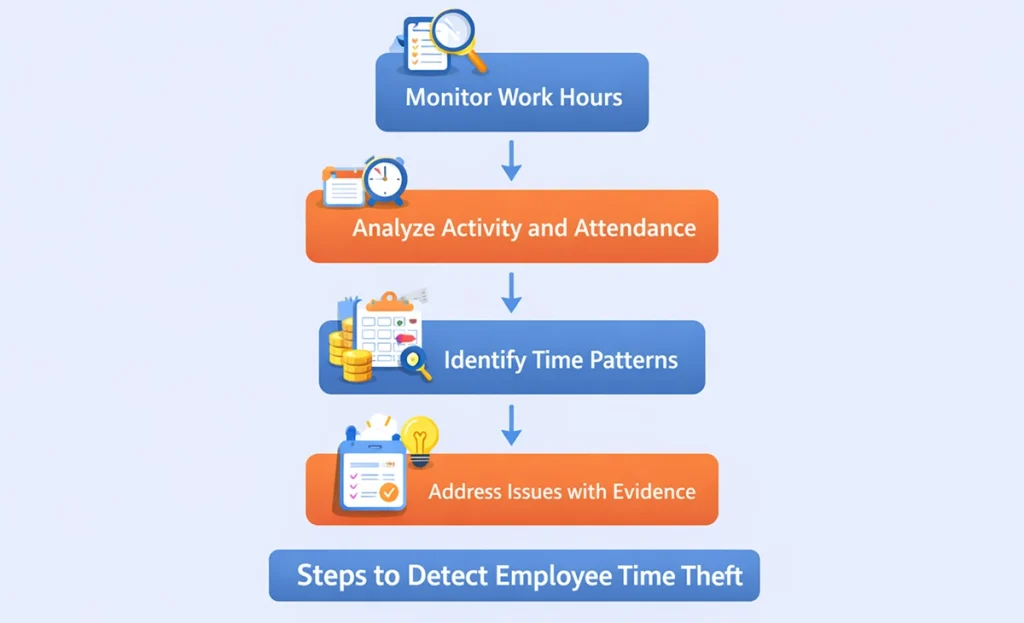
Time theft is one of the most overlooked workplace issues, yet it costs businesses thousands of dollars every year. Even small acts like logging extra minutes, taking longer breaks, or starting late can quickly add up. Studies and industry reports suggest that employee time theft can account for up to 5 percent of total payroll costs, making it a serious concern for employers across all industries.
Simply put, time theft occurs when employees are paid for hours they did not actually work. While some instances are intentional, many happen due to unclear expectations, weak timekeeping processes, or outdated tracking systems. In today’s remote and hybrid work environments, where visibility is reduced, identifying lost or unproductive work hours has become even more challenging for employers.
Common examples include logging hours not worked, taking extended breaks, arriving late, leaving early, or using work time for personal tasks. Whether accidental or deliberate, these behaviors lead to reduced productivity, higher payroll costs, and a gradual loss of trust between employees and management.
For businesses, understanding how employee work hours are tracked and where gaps exist is critical. Accurate time tracking and attendance management help ensure employees are compensated fairly while protecting organizations from payroll leakage and revenue loss. When work hours are recorded transparently and reviewed consistently, accountability improves without the need for micromanagement.
In this guide, we’ll explain what time theft is, explore the most common types found in the workplace, examine why it happens, and break down the real cost it creates for businesses. You’ll also learn how to identify time-related misuse, whether it’s illegal, and how organizations can prevent it through better processes and smarter tools like Clockdiary for accurate work-hour tracking.
By the end of this article, you’ll have a clear, practical understanding of employee time theft and the steps you can take to prevent it before it impacts productivity and profitability.
What Is Time Theft?
It happens when employees are paid for time they did not actually spend working. In simple terms, it occurs when recorded work hours do not accurately reflect the time spent on job related tasks. This issue affects businesses of all sizes and is common in office based, remote, and hybrid work environments.
It often goes unnoticed because it usually happens in small amounts. A few extra minutes added to work hours may not seem significant, but when repeated daily across teams, it can lead to reduced productivity and higher payroll costs. Without reliable timekeepingpractices, these losses can quietly continue over long periods.
Intentional vs Unintentional Time Theft
Not all time theft is done on purpose. Understanding the difference between intentional and unintentional time theft helps businesses respond fairly, improve policies, and prevent repeated issues.
Aspect
Intentional Time Theft
Unintentional Time Theft
Meaning
Employees knowingly misuse paid work hours
Employees misuse time due to mistakes or lack of awareness
Employee intent
Deliberate and conscious
Accidental or unaware
Common causes
Dishonesty, lack of supervision, low accountability
Unclear policies, poor tracking systems, lack of training
Typical examples
Logging hours not worked, staying clocked in during personal tasks, taking unauthorized extended breaks, working slowly to increase paid time
Forgetting to clock in or out, misunderstanding break rules, inaccurate manual time entries
Impact on payroll
Immediate and recurring payroll inflation
Gradual payroll errors over time
Frequency
Less common but more damaging per incident
More common in daily operations
How employers should respond
Audits, warnings, and disciplinary action if needed
Better policies, training, and clearer time tracking processes
Even when unintentional, it can still affect payroll accuracy if left unaddressed. Using structured tools like a timesheet helps businesses reduce errors, maintain consistency, and ensure work hours are recorded correctly.
Stealing Company Time Meaning
The phrase stealing company time refers to using paid work hours for activities that are not related to assigned job responsibilities. It does not always imply criminal behavior, but it does mean the employer is paying for time that is not productive.
Stealing company time can include:
Browsing social media or personal websites during work hours
Doing freelance or side work while clocked in
Repeatedly arriving late or leaving early
Extending simple tasks beyond what is reasonably required
When expectations around work hours are clearly defined and consistently tracked, employees are more likely to stay accountable. Transparent systems help businesses address time misuse without creating a culture of micromanagement or distrust.
What Is Considered Time Theft at Work?
Time theft at work includes any situation where employees are paid for time they are not actually working or being productive. It does not always involve extreme behavior. In most cases, it happens through everyday actions that slowly add up to lost work hours and increased payroll costs.
What is considered time theft often depends on company policies, but the core idea remains the same: paid time should be used for work related activities. When employees consistently use paid hours for non work tasks, it becomes time theft.
Common Examples of Time Theft at Work
Below are some of the most common situations that are considered employee time theft in the workplace.
Logging Hours Not Worked
Recording hours that were not actually worked is one of the clearest forms of time theft. This may include adding extra minutes or hours to a timesheet or clocking in earlier than work actually begins.
Using accurate time tracking methods makes it easier to verify logged hours and reduce payroll discrepancies.
Extended Breaks and Long Lunches
Occasionally taking a longer break may not seem serious, but consistently exceeding allowed break times is considered time theft. Over time, extended breaks can result in significant productivity loss, especially in hourly roles.
Clear break policies and regular review of work hours help prevent this issue.
Personal Internet and Phone Use
Checking personal messages or browsing social media briefly may be unavoidable, but excessive personal internet or phone use during paid work hours is considered time theft. When personal activities regularly interrupt work, productivity suffers.
This is especially common in remote work environments where supervision is limited.
Leaving Early or Arriving Late
Repeatedly arriving late, leaving early, or stepping away during scheduled work hours without approval is another common form of time theft. Even small time gaps can accumulate when they occur daily.
Monitoring start and end times through aclock in clock out system helps businesses identify patterns and address them early.
Doing Side Work During Paid Hours
Working on freelance projects, personal businesses, or non-work related tasks while on the clock is also considered time theft. Employers pay for dedicated work time, not divided attention.
Clear expectations and transparent tracking discourage this behavior without creating unnecessary pressure.
Why These Actions Are Considered Time Theft
Each of these examples has one thing in common: paid work hours are being used for something other than assigned job responsibilities. While a single incident may seem minor, repeated behavior affects productivity, payroll accuracy, and fairness across teams.
Employees who follow work hour rules may feel frustrated when others misuse time without consequences. Over time, this can weaken trust and accountability within the workplace.
How Employers Define Time Theft Clearly
To avoid confusion, employers should clearly define what is considered time theft in their organization. This includes:
Documented work hour and break policies
Clear expectations for remote and on site employees
Consistent review of recorded work hours
Transparent communication around time tracking
Using tools that track attendance and recorded hours consistently helps prevent misunderstandings and supports fair treatment for all employees.
Types of Time Theft in the Workplace
Time theft in the workplace can occur in many ways. Some are easy to spot, while others are subtle and often go unnoticed. Recognizing the different forms of employee time misuse helps organizations identify recurring patterns, address issues early, and apply fair and consistent corrective actions before productivity and trust are affected.
Buddy Punching
Buddy punching occurs when one employee clocks in or clocks out on behalf of another employee who is not actually present. This is a common issue in workplaces that rely on manual attendance systems or shared access methods.
Buddy punching leads to inaccurate attendance records and direct payroll loss. It also creates unfairness among employees who follow attendance rules.
Using attendance tools or systems that verify employee presence helps prevent this type of abuse.
Time Clock Theft
Time clock theft happens when employees manipulate clock in and clock out times to record more hours than they worked. This may include clocking in early, clocking out late, or staying logged in without actively working.
This type of time theft is common in organizations that lack structured attendance controls. A reliable employee attendance tracker helps businesses identify irregular clocking patterns and maintain accurate records.
Extended or Unauthorized Breaks
Taking breaks longer than permitted or stepping away frequently without approval is another common form of time theft. While short breaks are normal, repeated or excessive break time reduces actual working hours.
This issue is often seen in roles with limited supervision and flexible schedules. Clear break policies and consistent monitoring reduce misuse without harming employee trust.
Unauthorized Overtime
Unauthorized overtime occurs when employees work extra hours without approval or intentionally slow down tasks to qualify for overtime pay. While overtime itself is not time theft, claiming overtime without legitimate work is considered misuse of paid time.
Monitoring overtime patterns alongside payroll cycles helps businesses identify irregularities. Reviewing overtime data during payroll schedules makes it easier to spot repeated abuse.
Personal Activities During Work Hours
Using paid work time for personal tasks such as browsing social media, shopping online, or handling personal calls is one of the most common types of time theft. Occasional personal use may be unavoidable, but excessive personal activity during work hours affects productivity.
This form of time theft is especially common in remote and hybrid work environments where visibility is lower.
Remote Employee Time Theft
Remote employee time theft happens when employees working from home misuse flexible schedules or lack of direct supervision. This may include logging hours without working, being unavailable during scheduled hours, or frequently stepping away without notice.
Businesses managing distributed teams benefit from clear expectations and structured processes to monitor remote employees productivity without micromanagement.
Why Do Employees Steal Time at Work?
Employees do not always steal time because of bad intentions. In many cases, employee time theft is a symptom of deeper workplace issues such as poor engagement, unclear expectations, or burnout. Understanding why time theft happens helps employers address the root cause instead of only treating the surface problem.
Below are the most common reasons employees steal time at work.
Lack of Engagement and Motivation
When employees feel disconnected from their work, they are more likely to misuse paid time. Low engagement often leads to distractions, slow task completion, and reduced accountability.
Employees who do not feel valued or challenged may stretch tasks unnecessarily or spend time on non work activities during paid hours. Focusing on how to improve employee engagementplays a key role in reducing employee time theft.
Burnout and Overwork
Burnout is another major reason behind time theft. Employees who are overworked or mentally exhausted may take longer breaks, step away frequently, or reduce their effort just to cope with stress.
In these cases, time theft is not intentional misconduct but a signal that workloads may be unrealistic. Supporting work life balance and managing expectations helps reduce burnout driven time misuse.
Poor Management and Supervision
Time theft often increases in workplaces where supervision is inconsistent or expectations are unclear. When employees are unsure how their time is reviewed or measured, accountability naturally drops.
Poor communication from managers, lack of feedback, and inconsistent enforcement of rules can all contribute to time theft behaviors.
Unclear Time and Attendance Policies
Employees are more likely to misuse time when work hour rules are not clearly defined. Confusion around break lengths, start times, end times, or remote availability often leads to unintentional time theft.
Clear documentation and communication of policies help employees understand what is expected and reduce reporting errors.
Lack of Accountability Systems
When employees believe their time is not being reviewed, misuse becomes easier. Without reliable systems in place, inaccurate time reporting may go unnoticed.
Using tools that help track employee hours creates transparency and encourages responsible time use without micromanagement.
Remote Work Challenges
Remote and hybrid work environments introduce unique challenges. Limited visibility, flexible schedules, and communication gaps can make it easier for time misuse to happen.
Employees may log hours while multitasking or stepping away frequently. Managing distributed teams requires clear expectations and strategies for managing virtual teams to reduce remote employee time theft.
How Much Does Time Theft Cost Employers?
Time theft can cost employers thousands of dollars each year, even when it happens in small amounts. Losing just a few minutes per employee every day may not seem serious, but when those minutes are added up across teams and months, the financial impact becomes significant.
For example, if one employee wastes 15 minutes per day, that adds up to:
Over 5 hours per month
More than 60 hours per year
For a team of 20 employees, that becomes 1,200 paid hours per year with little or no productive output. When multiplied by average hourly wages, the cost of employee time theft can quickly reach tens of thousands of dollars annually.
Productivity Loss Due to Time Theft
It is directly reduces productivity. When employees misuse paid hours, tasks take longer to complete, output declines, and deadlines are missed.
Even a 5 percent drop in productivity across a team can have a noticeable impact on business performance. Tracking performance using clear business metrics helps organizations understand how lost work time affects overall efficiency and output.
Payroll and Financial Impact
It inflates payroll costs because employers are paying wages without receiving equivalent work. This impact is especially noticeable in hourly and overtime based roles.
For instance:
Paying an employee $25 per hour for 1 extra unworked hour per week results in $1,300 per year per employee
Across 10 employees, that equals $13,000 annually
Understanding real labor costs requires looking beyond logged hours. Measuring output through methods like how to calculate productivity of an employee provides a clearer picture of how much value those paid hours actually generate.
Hidden Costs of Time Theft
The true cost of time theft goes beyond wages. Many expenses are indirect and harder to measure, including:
Overtime paid to cover unfinished work
Project delays and missed deadlines
Increased management time spent correcting issues
Reduced efficiency across teams
These hidden costs often exceed direct payroll losses, especially when time theft becomes a regular pattern.
Impact on Team Morale and Trust
It also affects team dynamics. When employees see coworkers misusing time without consequences, trust erodes.
This can lead to:
Lower morale among high performing employees
Reduced accountability
Decreased engagement
Higher turnover over time
These outcomes carry long term costs that are difficult to reverse once workplace trust is damaged.
Why the Cost of Time Theft Is Often Underestimated
Many businesses underestimate time theft because it rarely appears as a single large expense. Instead, it shows up as small, repeated losses spread across daily operations.
Without reviewing work hours alongside productivity and output, employers may never see the full financial impact. Over time, these unnoticed losses quietly reduce profitability.
Signs of Employee Time Theft
Employee time theft is not always obvious. In many cases, it shows up through patterns and inconsistencies rather than single incidents. Recognizing the early signs helps employers take corrective action before time misuse becomes a larger problem.
Below are some of the most common signs of employee time theft in the workplace.
Inconsistent or Inaccurate Time Records
One of the earliest signs of time theft is inconsistency in recorded work hours. This may include frequent changes to logged hours, missing clock outs, or identical time entries day after day.
When time records do not align with actual work output, it can indicate inaccurate reporting. Reviewing time data regularly helps identify these discrepancies early.
Low Productivity Compared to Logged Hours
If an employee logs full work hours but consistently delivers less output, it may be a sign of time misuse. While productivity can vary, a repeated mismatch between hours worked and results is a red flag.
Tracking output alongside time helps businesses spot gaps between effort and performance. Measuring efficiency using how to calculate productivity of an employee makes these patterns easier to identify.
Frequent Extended Breaks
Taking occasional longer breaks may not be an issue, but repeated or unexplained extended breaks often signal time theft. This is especially noticeable in roles with flexible schedules or limited supervision.
Over time, frequent breaks reduce actual working hours and affect team productivity.
Repeated Overtime Patterns Without Clear Justification
Another sign of employee time theft is repeated overtime without corresponding increases in workload or output. This may indicate employees are slowing down regular tasks to qualify for additional paid hours.
Reviewing overtime trends alongside work schedules helps identify patterns that do not align with business needs.
Poor Availability During Scheduled Work Hours
Employees who are often unavailable during scheduled hours, slow to respond, or frequently offline may be misusing paid time. This issue is especially common in remote or hybrid work environments.
Clear expectations around availability and structured systems to monitor remote employees productivity help address this issue without micromanagement.
Repeated Late Starts or Early Log Offs
Consistently starting late or logging off early without approval is another sign of time theft. While occasional schedule changes happen, repeated behavior can indicate misuse of paid work hours.
Using attendance tools that record start and end times helps businesses spot these trends and address them fairly.
How to Detect and Uncover Time Theft
Detecting time theft requires more than suspicion. Employers need clear processes and reliable data to uncover time misuse fairly and accurately. The goal is not to spy on employees, but to identify patterns that indicate inaccurate time reporting or misuse of paid hours.
Below are effective and ethical ways to detect employee time theft.
Compare Time Tracking Data With Actual Output
One of the most reliable ways to uncover time theft is to compare logged work hours with actual results. When employees consistently log full hours but produce less output, it signals a potential issue.
Tracking both time and performance side by side helps reveal gaps between effort and results. Using tools that support time tracking tips makes it easier to review patterns and identify inconsistencies early.
Conduct Regular Time and Attendance Audits
Regular audits of time and attendance records help uncover irregular entries such as identical work hours every day, frequent edits, or missing clock outs.
Audits should focus on patterns, not individual mistakes. Reviewing attendance data consistently encourages accurate reporting and reduces repeat misuse over time.
Review Overtime and Break Reports
Overtime and break data can reveal hidden time theft. Repeated overtime without workload changes or excessive break durations often point to inefficient or dishonest time use.
Analyzing overtime trends alongside work schedules helps employers spot behaviors that inflate payroll without increasing productivity.
Monitor Remote Teams Ethically
Remote work introduces unique challenges when it comes to visibility. Employees may log hours while multitasking or stepping away during scheduled work time.
Instead of constant surveillance, employers should focus on outcomes and availability. Following ethical employee monitoring practices helps uncover time theft while respecting employee privacy.
Use Reports to Identify Patterns Over Time
Time theft is rarely uncovered through a single incident. It usually appears through repeated patterns over weeks or months.
Using detailed reports helps employers track attendance, overtime, break usage, and availability trends. Reviewing these reports regularly allows businesses to address issues early and consistently.
How Clockdiary Helps Prevent and Detect Time Theft
Preventing and detecting time theft requires more than manual checks or assumptions. Businesses need clear visibility into how work hours are actually spent. Clockdiary helps employers reduce employee time theft by combining accurate time tracking, activity visibility, and detailed reporting that highlights inconsistencies between logged time and real work.
Instead of relying on trust alone or invasive monitoring, Clockdiary focuses on transparency and accountability, making it easier to identify time misuse early and address it fairly.
Activity Tracker That Shows How Time Is Spent
Clockdiary includes an activity tracker that records work activity during tracked hours. This allows employers to see whether logged time aligns with actual work being performed.
By reviewing activity levels alongside tracked hours, managers can quickly identify patterns such as long idle periods, frequent distractions, or repeated gaps during paid time. These insights are especially useful when reviewing concerns related to employee time theft without relying on guesswork.
This level of visibility is helpful for both office based and remote teams, where understanding how time is used can otherwise be challenging.
Automatic Time Tracking Reduces Reporting Errors
Manual time entry is one of the most common causes of inaccurate work hours. Employees may forget to start or stop timers, or unintentionally log more time than they worked.
Clockdiary uses automatic tracking to record work sessions accurately, which reduces mistakes and improves consistency. This makes it easier for employers to track employee hours and spot irregularities before they affect payroll.
Accurate tracking also supports better attendance management, especially for teams with flexible schedules.
Reports That Highlight Time Theft Patterns
Clockdiary provides detailed reports that help employers review time data across employees, projects, and days. These reports make it easier to compare logged hours with activity levels and output.
Managers can use reports to identify trends such as repeated overtime without workload changes, frequent idle time, or inconsistent attendance. Reviewing these patterns alongside an employee attendance tracker helps uncover time theft issues that may otherwise go unnoticed.
Better Accountability Without Micromanagement
Clockdiary helps businesses maintain accountability without constant supervision. When employees know their time and activity are being tracked transparently, they are more likely to stay focused during paid work hours.
This approach supports ethical employee monitoring, where the goal is clarity and fairness rather than control.
Clear records also help managers address concerns with evidence instead of assumptions, which improves trust and communication.
Strong Support for Remote and Hybrid Teams
Time theft risks are often higher in remote and hybrid work environments. Limited visibility and flexible schedules can make it harder to identify time misuse.
Clockdiary helps distributed teams stay aligned by providing clear work hour data and activity summaries. This supports better collaboration and makes it easier to monitor remote employees productivity without harming morale.
By setting clear expectations and reviewing time data regularly, businesses can reduce remote employee time theft while supporting flexible work models
Is Time Theft Illegal or a Crime?
Whether time theft is illegal or considered a crime depends on how it happens, how severe it is, and how company policies and local laws define it. In most cases, It is treated as a workplace misconduct issue rather than a criminal offense.
For employers, understanding the legal side of time theft is important so they can respond appropriately without overreacting or ignoring serious cases.
Is Time Theft Illegal?
In general, time theft is not automatically illegal. Most instances of employee time theft are considered violations of company policy, not violations of the law.
Examples such as taking longer breaks, arriving late, or logging slightly inaccurate hours are usually handled internally through warnings or disciplinary action. These situations typically fall under time and attendance policy enforcement rather than legal action.
However, time theft can become a legal issue if it involves deliberate misrepresentation of work hours that results in financial loss to the employer.
Is Time Theft a Crime?
It becomes a crime only in serious or repeated cases where there is clear intent to commit fraud. This usually involves knowingly falsifying time records or manipulating systems to receive pay for hours not worked.
Examples that may cross into criminal territory include:
Falsifying time records on purpose
Repeatedly claiming pay for work never performed
Coordinated time fraud involving multiple employees
In these situations, It may be classified as fraud rather than a simple workplace issue. Employers often need clear documentation and evidence before taking legal action.
Is Time Theft a Felony?
In most cases, time theft is not a felony. Felony charges are typically reserved for large scale or high value fraud cases.
It may only be treated as a felony if:
The financial loss is significant
The behavior is ongoing and intentional
Local laws classify the action as serious fraud
For most businesses, time theft cases never reach this level and are resolved internally.
When Time Theft Becomes Fraud
It becomes fraud when an employee knowingly and intentionally misleads an employer for financial gain. The key factor here is intent.
Courts and regulators usually look for:
Clear evidence of deliberate deception
Repeated behavior over time
Measurable financial loss
This is why maintaining accurate records of work hours, attendance, and activity is so important. Clear documentation protects businesses if legal questions arise later.
Understanding how work hours are defined for different employee types such as exempt vs non exempt employees also helps avoid legal confusion.
How Employers Should Handle Time Theft Legally
Most employers should treat it as a policy and performance issue first, not a legal one. Best practices include:
Reviewing documented work hours and patterns
Communicating concerns clearly with employees
Applying consistent disciplinary steps
Escalating only when there is strong evidence of fraud
Clear policies and proper documentation help businesses act fairly and legally.
Employee Time Theft Punishment
Employee time theft punishment should be fair, consistent, and proportionate to the severity of the behavior. In most workplaces, time theft is handled as a performance or conduct issue rather than an immediate legal matter. The goal is to correct behavior, protect company resources, and maintain fairness across teams.
Punishment often depends on whether the time theft was intentional, how often it occurred, and how much impact it had on productivity and payroll.
Verbal and Written Warnings
For minor or first time incidents, employers usually begin with verbal or written warnings. This approach is especially appropriate for unintentional time theft caused by misunderstandings or unclear expectations.
Warnings should clearly explain:
What behavior was identified
Why it violates company policy
What is expected going forward
Documenting these warnings helps establish a clear record if the issue continues.
Disciplinary Action
If time theft continues after warnings, employers may apply formal disciplinary action. This may include closer supervision, loss of privileges, or performance improvement plans.
Disciplinary steps should be applied consistently to avoid perceptions of favoritism. Reviewing work hours and productivity data regularly helps support fair decisions. Understanding how to calculate productivity of an employee can help managers evaluate whether paid time aligns with output.
Termination for Time Theft
Termination may be necessary in cases of repeated or intentional time theft. When employees knowingly falsify work hours or ignore previous warnings, dismissal is often considered a justified response.
Before terminating an employee for time theft, employers should ensure:
Clear evidence exists
Policies were communicated clearly
Disciplinary steps were followed consistently
This protects the business and reduces the risk of disputes.
Legal Consequences in Severe Cases
In rare situations, time theft may lead to legal consequences. This usually applies only when there is clear intent to commit fraud and significant financial loss.
Most cases do not reach this level, but proper documentation and consistent enforcement of policies help businesses respond appropriately if legal questions arise.
Importance of Clear Policies and Consistent Enforcement
Clear time and attendance policies play a critical role in preventing time theft and enforcing punishment fairly. Employees should understand:
How work hours are tracked
What behaviors are considered time theft
What consequences apply to violations
When policies are clearly defined and enforced consistently, time theft issues are easier to manage and less likely to escalate.
How to Prevent Time Theft in the Workplace
Preventing time theft starts with clarity, transparency, and consistent processes. Instead of reacting after issues occur, employers should focus on creating systems and expectations that naturally discourage time misuse.
Below are proven ways businesses can prevent employee time theft while maintaining trust and productivity.
Use Reliable Time Tracking Software
Accurate time tracking is one of the most effective ways to prevent time theft. When employees know their work hours are recorded clearly and consistently, misuse becomes less likely.
Using structured time tracking software helps businesses record work hours automatically, reduce manual errors, and maintain accurate payroll records.
Automate Attendance and Break Tracking
Manual attendance systems often lead to mistakes and inconsistencies. Automating attendance and break tracking helps ensure employees are clocking in and out correctly and taking breaks within allowed limits.
Clear attendance records make it easier to address issues early and fairly, before they become patterns.
Set Clear Time and Attendance Policies
Employees are less likely to misuse time when expectations are clearly defined. Businesses should document rules around:
Start and end times
Break duration
Overtime approval
Remote availability
Clear policies reduce confusion and help prevent unintentional time theft.
Review and Approve Timesheets Regularly
Regular review of work hours helps catch inaccuracies early. Approving timesheets consistently signals that time reporting is taken seriously.
Understanding how to fill out a timesheet correctly also helps employees avoid mistakes that can lead to payroll errors.
Track Productivity Alongside Work Hours
Preventing time theft is not just about tracking hours. It is also about understanding output.
Comparing logged hours with actual results helps identify inefficiencies and misuse. Reviewing business metrics allows employers to see whether paid time aligns with performance.
Encourage Transparency and Accountability
When employees understand how time is tracked and reviewed, accountability improves naturally. Transparency creates fairness and reduces the need for strict enforcement.
Open communication about expectations and performance helps employees stay aligned with company goals.
Reward Honest and Productive Employees
Recognizing employees who consistently use their time responsibly reinforces positive behavior. Rewards do not always need to be financial. Public recognition, flexible schedules, or growth opportunities can be powerful motivators.
Focusing on positive reinforcement helps prevent time theft by encouraging ownership and responsibility.
Preventing Time Theft Without Micromanaging Employees
Preventing time theft does not mean constantly watching employees or controlling every minute of their workday. In fact, excessive monitoring often leads to lower morale, reduced trust, and disengagement. The goal is to create accountability while still respecting employee autonomy.
Businesses that focus on transparency, outcomes, and trust are more successful at reducing time theft than those that rely on strict supervision alone.
Focus on Outcomes Instead of Constant Oversight
One of the most effective ways to prevent time theft without micromanaging is to shift focus from hours alone to results. When employees are evaluated based on completed work rather than constant availability, they are more likely to manage their time responsibly.
Tracking progress using clear goals and deliverables allows managers to identify performance gaps without watching every action. This approach works especially well for knowledge workers and remote teams.
Use Ethical and Transparent Monitoring Practices
Monitoring should always be ethical and clearly communicated. Employees should understand what data is collected, why it is collected, and how it is used.
Using ethical employee monitoring practices helps businesses maintain visibility into work patterns without invading privacy or damaging trust.
Transparency around monitoring reduces resistance and encourages responsible behavior.
Build Trust Through Clear Expectations
Trust begins with clarity. When employees know what is expected regarding work hours, availability, and output, they are less likely to misuse time.
Setting clear expectations around schedules, communication, and deadlines helps employees manage their time independently while staying accountable.
Support Work Life Balance to Reduce Burnout
Burnout often leads to disengagement and time misuse. Employees who are exhausted may take longer breaks or lose focus during work hours.
Supporting healthy work routines and encouraging balance helps reduce burnout driven time theft. Businesses that promote balance often see higher engagement and better productivity over time.
Encourage Ownership and Self Accountability
Employees are more responsible when they feel ownership over their work. Encouraging self management, regular check ins, and open feedback creates a culture where employees take responsibility for how they use their time.
Providing tools that help employees track and reflect on their own work patterns supports accountability without pressure.
Use Productivity Insights as Guidance, Not Control
Data should be used to guide conversations, not enforce constant control. Productivity insights are most effective when they help identify where support or clarification is needed.
Reviewing patterns using productivity trackers allows managers to address time misuse constructively rather than punitively.
Time Theft in Remote and Hybrid Work Environments
Remote and hybrid work environments offer flexibility, but they also change how work hours are managed and monitored. With fewer visual cues and more flexible schedules, time theft can be harder to detect if clear systems are not in place.
The issue is not remote work itself. In most cases, time theft occurs because of unclear expectations, weak structure, or lack of visibility into how time is being used.
Common Remote Work Time Theft Myths
Many employers assume remote employees misuse time more often than office based teams. This belief often leads to unnecessary control and mistrust.
Common myths include:
Remote employees are less productive
Flexible schedules reduce accountability
Time tracking does not work outside the office
In reality, productivity depends more on structure and communication than physical location. Using the right work from home apps helps teams stay focused and aligned without constant supervision.
Real Risks of Time Theft in Remote and Hybrid Teams
While remote work does not automatically cause time theft, certain risks are more common when teams are distributed.
These risks include:
Logging hours while handling personal tasks
Being unavailable during scheduled work time
Taking extended breaks without communication
Inconsistent start and end times
Without visibility into work patterns, these behaviors can continue unnoticed. Reviewing time data alongside clear remote processes helps reduce these risks.
Best Practices for Managing Time in Distributed Teams
Preventing time theft in remote and hybrid teams requires balance. Employers need visibility without control and structure without pressure.
Effective practices include:
Creating clear guidelines for availability and response times
Tracking completed tasks instead of constant online presence
Reviewing work hours and output regularly
Clear systems help employees manage their time responsibly while giving managers confidence in recorded hours.
Hybrid Work Requires Even More Clarity
Hybrid work models combine remote and in office schedules, which can increase confusion around expectations. Without clarity, employees may unintentionally misuse time when switching between work environments.
Defining schedules, availability, and tracking rules is essential for teams using a hybrid work model.
Clear policies ensure fairness across both remote and in office employees.
Why Communication Is Critical in Remote Teams
Communication gaps are one of the biggest contributors to time misuse in remote environments. When employees are unsure about priorities or expectations, productivity suffers.
Encouraging clear and structured asynchronous communication helps teams stay aligned without constant meetings or check ins.
Strong communication reduces misunderstandings and supports responsible time use.
Conclusion
It may seem minor at first, but even small daily time losses can add up to significant productivity and payroll costs over time. From extended breaks and inaccurate time entries to remote work challenges, time theft affects businesses of all sizes and industries.
The good news is that it can be prevented with the right approach. Clear policies, transparent communication, and accurate time tracking help create accountability without damaging trust. By focusing on real work patterns instead of assumptions, businesses can reduce time misuse while supporting employee productivity.
Understanding how time theft happens and taking proactive steps to address it allows organizations to protect their time, resources, and team performance in the long run.
What is time theft?
Time theft happens when an employee is paid for time they did not actually spend working. This can include logging extra hours, taking extended breaks, or using paid work time for personal activities. Time theft can be intentional or unintentional and often goes unnoticed without proper tracking systems.
What is the best software to prevent time theft at work?
The best software to prevent time theft accurately tracks work hours, monitors activity during work time, and highlights inconsistencies, and tools like Clockdiary do this by combining time tracking, activity tracking, and attendance insights.
What is an example of time theft at work?
A common example of time theft is an employee clocking in on time but spending a significant portion of their work hours on personal phone use or unrelated tasks. Other examples include leaving early without approval, logging hours not worked, or doing side work during paid hours.
Is time theft illegal?
In most cases, time theft is not illegal. It is usually treated as a violation of company policy rather than a legal offense. However, if time theft involves deliberate falsification of records and financial loss, it may become a legal issue depending on local laws.
Is time theft a crime or a felony?
It is rarely considered a crime and is almost never a felony. It may only be treated as criminal fraud in severe cases involving intentional and repeated misrepresentation of work hours and significant financial impact.
Can employees go to jail for time theft?
It is very uncommon for employees to go to jail for it. Most cases are handled internally through warnings, disciplinary action, or termination. Legal action is typically reserved for extreme cases involving clear fraud.
Can you terminate an employee for time theft?
Yes, employers can terminate an employee for time theft, especially if the behavior is repeated or intentional. Termination should be based on documented evidence and applied consistently according to company policy.
What is buddy punching?
Buddy punching occurs when one employee clocks in or clocks out on behalf of another employee who is not present. It leads to inaccurate attendance records and payroll loss. Using tools like clock in clock out apps helps businesses prevent this behavior by ensuring employees record their own work hours accurately.
How can employers prevent time theft?
Employers can prevent time theft by setting clear policies, tracking work hours accurately, reviewing time data regularly, and focusing on transparency rather than constant supervision. Using reliable tools and encouraging accountability across teams also reduces time misuse.
Is time theft more common in remote work?
It is not inherently more common in remote work, but it can be harder to detect without clear systems. Remote teams benefit from structured processes, clear expectations, and tools that provide visibility into work hours and output.


 Kapil Garg